
Which business English phrases help you sound clear and professional?
Short answerClear business English is short and specific: say what you need, by when, and why. “Following up on this — could you confirm the budget by Thursday?” beats “As per my last email…”. When you disagree, use facts and offer an alternative. When asked for an opinion, choose one option and give your main reason.
Last updated 2026-10-23
How do you follow up without sounding annoyed?
“Following up on this — could you confirm the budget by Thursday?”
Instead of: “As per my last email, I already asked…”
Assume they’re busy, not ignoring you.
“A quick yes or no is fine.”
Lower the effort and you’ll get a faster reply.
“While we’re all here — can we decide on the budget?”
Some decisions are faster spoken than written.
How do you push back on a deadline politely?
“Friday is possible if we leave out the export feature.”
Instead of: “That’s impossible.”
Show what it would take, not just that it’s hard.
“We can ship a smaller version Friday, or the full version next Wednesday.”
Two options turn a ‘no’ into a planning conversation.
“Which matters more for this release — the date or the export?”
Let the person with the priorities make the call.
How do you disagree with your manager respectfully?
“Can I share a concern about the timeline?”
It signals respect and gets their attention.
“Last time, testing took ten days. One week may not be enough.”
Instead of: “I feel like it’s too fast.”
Evidence makes disagreement easier to accept.
“Could we launch to 10% of users first?”
An alternative keeps the conversation moving.
How do you give a recommendation in English?
“I’d go with option B.”
Instead of: “Well, both are good, it depends…”
Start with one choice — you can change your view later.
“It’s cheaper, and the team already knows it.”
One or two reasons is enough.
“The only risk is support — but we can test it for a month.”
Naming a risk shows you’ve thought it through.
What should you say in a stand-up update?
“Yesterday I finished the login screen.”
Instead of: “I worked on some stuff for the login…”
Use a result, not an activity.
“Today I’m connecting it to the new API.”
One main task is enough.
“I need the API key from Sam to test it.”
Name the blocker clearly — or say “No blockers.”
What do you say in small talk before a meeting?
“How’s your week going so far?”
Open questions invite more than a yes or no.
“Busy, but good — we just launched the new dashboard.”
One detail gives them something to reply to.
“Great — shall we get started?”
A short bridge sentence moves you into the meeting.
Practise these phrases out loud
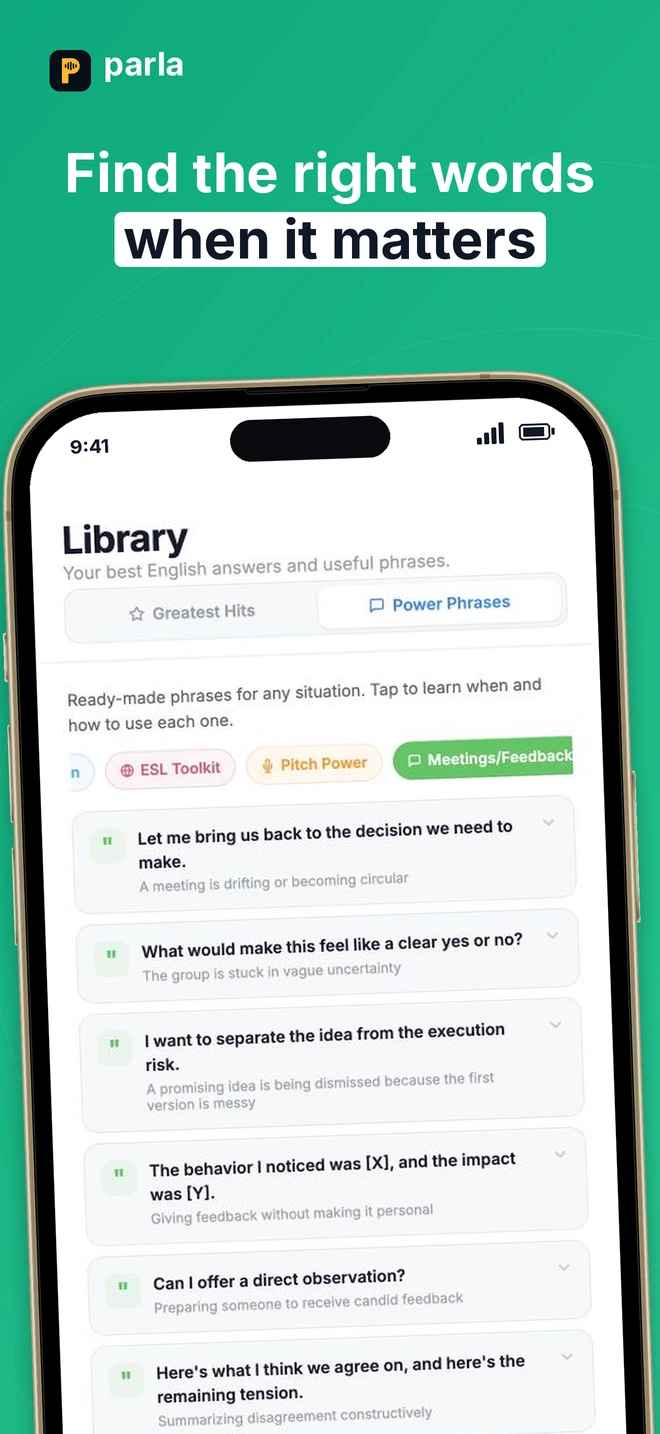
Reading a phrase is not the same as saying it under pressure. In Parla: English for Work, you record a 30–90 second answer to a real work situation and get feedback on clarity, pace and filler words — plus a clearer version to try again.

Questions people ask
What is a polite alternative to “As per my last email”?
Try “Following up on this — could you confirm the budget by Thursday?” It names what you need and when, without sounding frustrated.
How do I say no to a deadline in English?
Name the trade-off instead of saying “impossible”: “Friday is possible if we leave out the export feature.” Then offer two options and ask which matters more.